

WORK IN PROGRESS
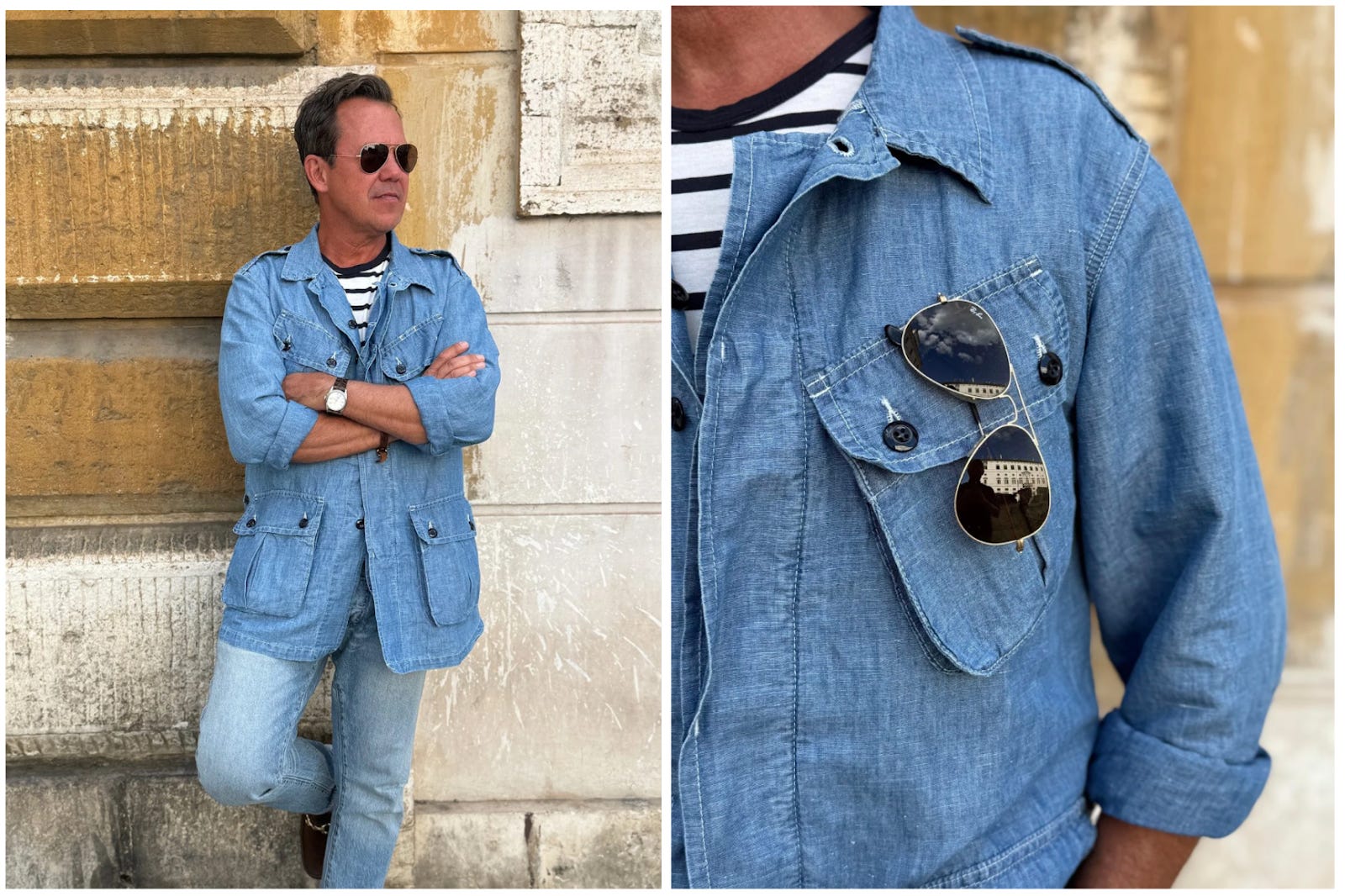
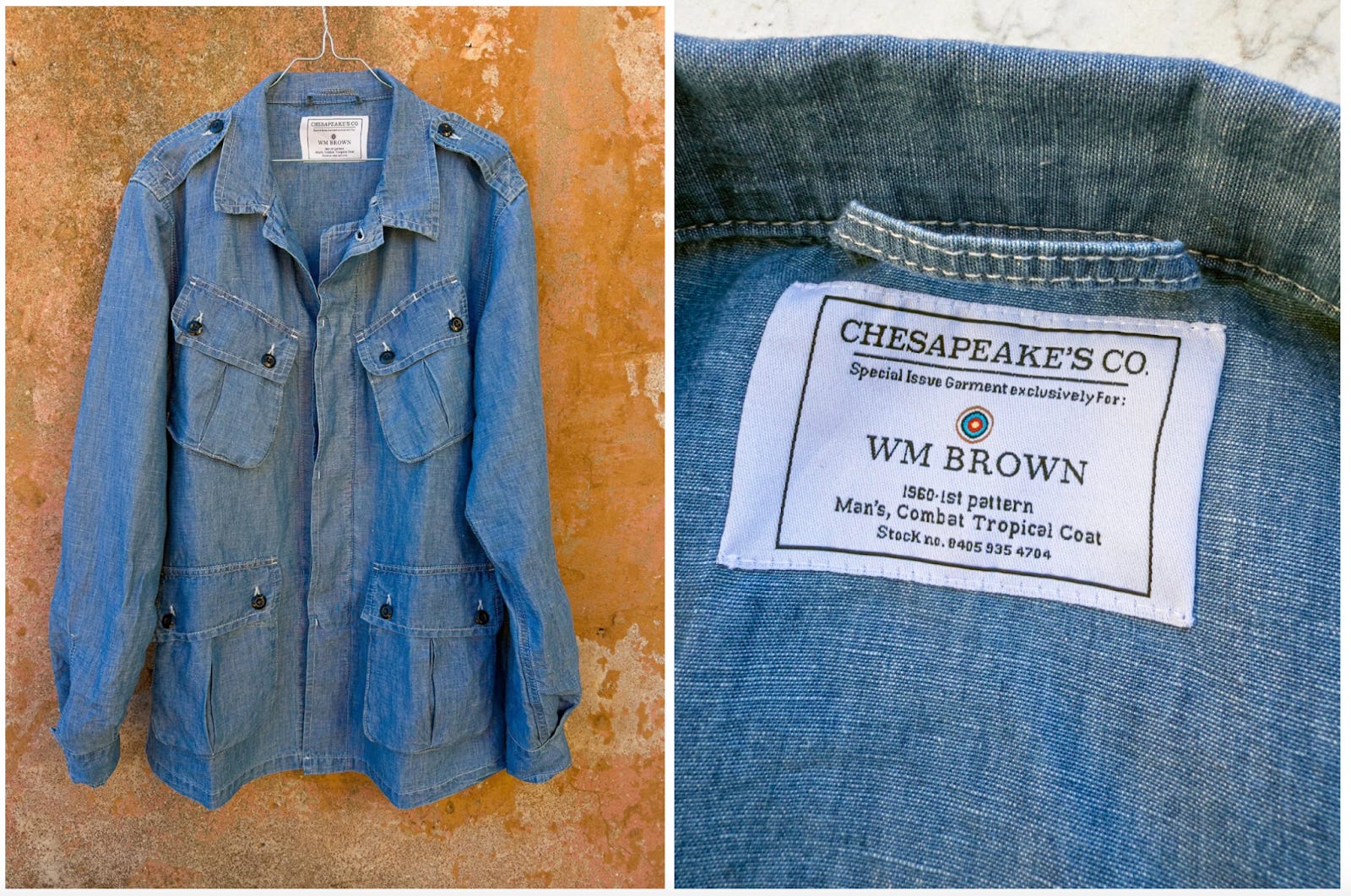
Back in May I introduced my own iteration of the jungle jacket, made in collaboration with the Italian menswear brand Chesapeake’s. Based on the U.S. Army’s lesser known first-pattern jungle jacket and available in a deep navy blue, it promptly sold out.
So for fall, we’re giving anyone who missed out the first time around—or wants to double down—another take on that jacket, this time made from a cotton-hemp chambray with a rich, dry hand. I love the way that chambray pushes it beyond the garment’s original parameters, and makes what’s become a part of the modern menswear uniform feel original again.
It’s weighted enough that it can be worn in fall as part of a layered look, and we’re angling to ship them out to customers mid-November. But in order to do so, we have to close the pre-order this Sunday, October 5th. So if you want one, don’t wait!
WRIST CHECK
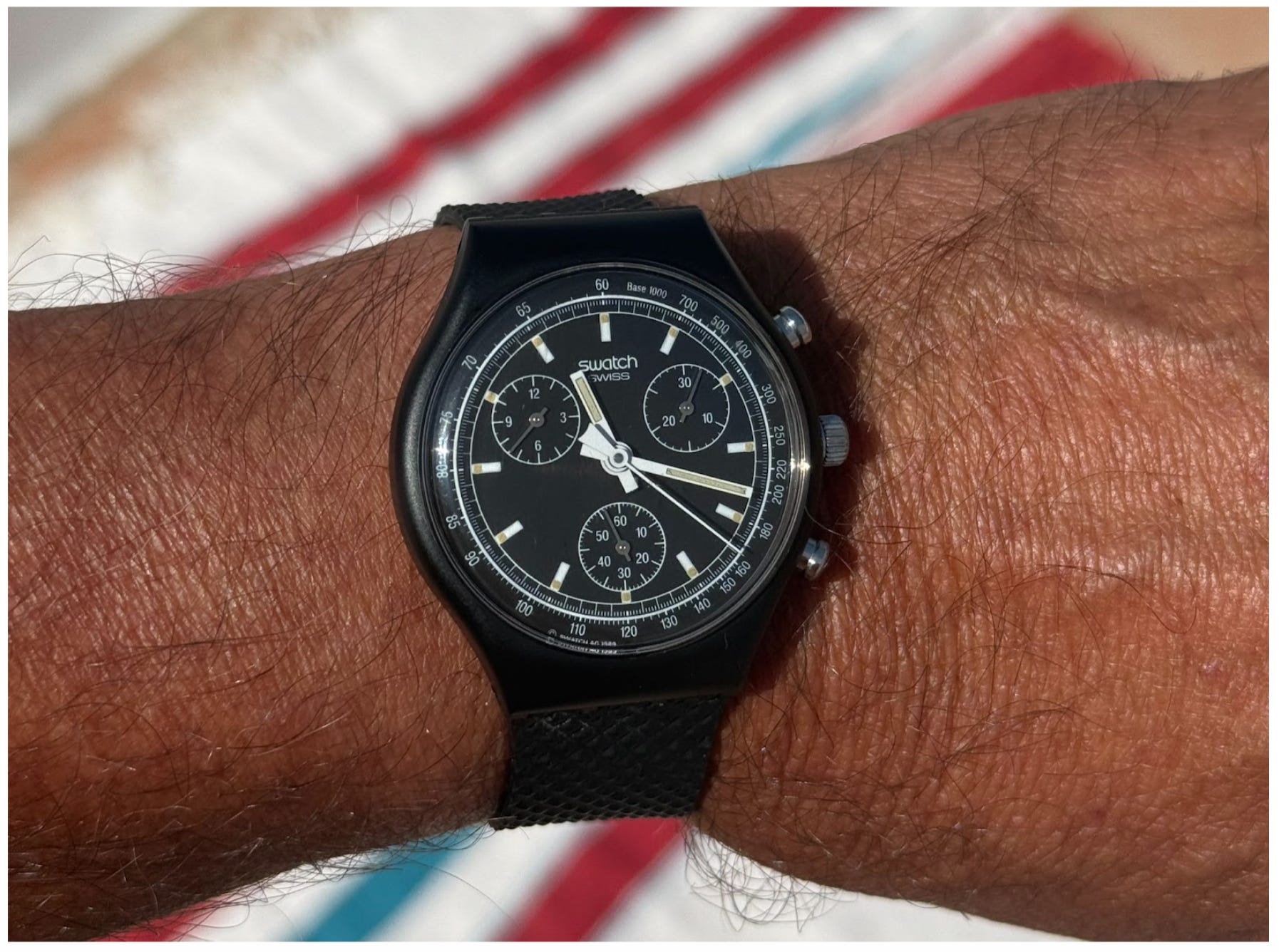
I’ve worn this 1990 Swatch Chronograph this entire summer (actually until two days ago!)—far more than any other watch. I found it in Rome at a great little kiosk near our apartment where a young couple has set up shop selling vintage, paintings, books, watches and other trinkets. I discovered the Chronograph amid the few trays of deadstock Swatches they had—there were plenty of cool graphics and the sort of designs you expect from the ‘80s and ‘90s, but this stark black watch stood out. It was complete in its original packaging and the price was right—$100.
I’ve had a soft spot in my heart for Swatch since the 1980s, as it was the very first Swiss watch brand I owned. My introduction was a graphic blue Chronograph not so different from this one, and I’ve owned many since. This latest acquisition served its purpose this summer during trips to Naples (never wear a Rolex!), swims in the sea, morning workouts, runs, and tennis. I wore it in the sauna and showered with it, without the worry I would have had for my other vintage pieces. Most of all, I think it’s great looking and it was a beautiful addition to my collection.
P.S: After I posted a photo of it, the great watch designer Giorgo Galli sent me a DM saying that he’d helped design it during his time at Swatch. I’m such a fan of his designs (he’s currently the Design Director at Timex) and I replied that I had a feeling that was the case!
DEMYSTIFYING: CIGAR COGNAC

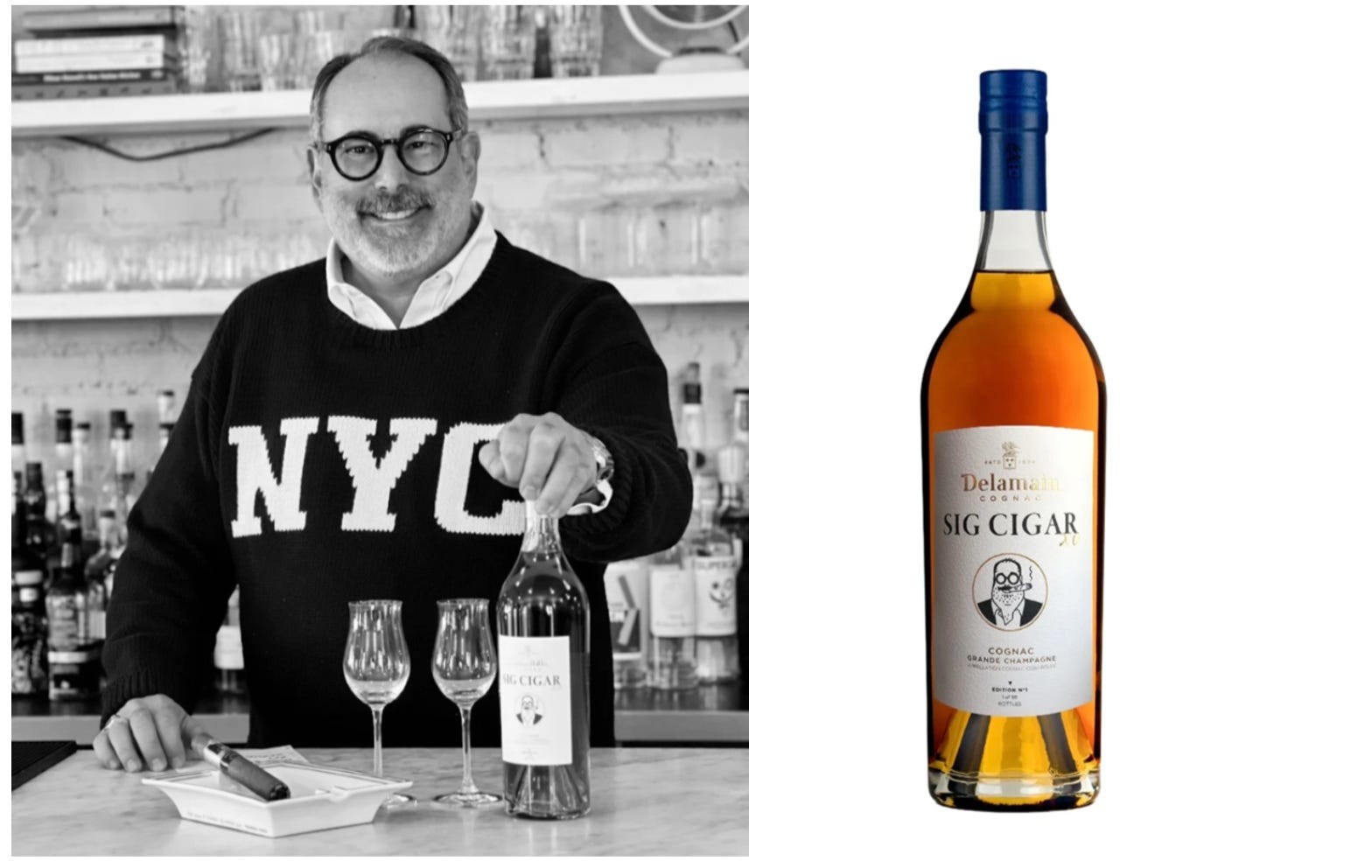
Aaron “Sig” Sigmond—our resident Smoking Section columnist and author of CIGARS: A Biography—just released his very own cigar Cognac in collaboration with the 201-year-old maker Cognac Delamain, Delamain SIG CIGAR XO, available exclusively at Collezione New York. We thought it was the perfect opportunity to pick Sig’s brain on what makes a cigar Cognac, and how the two are best enjoyed together—or alone.
What is a cigar Cognac?
Truth be told, any Cognac (or Armagnac, even Marc de Bourgogne) can be paired with a particular cigar to create an ideal balance of mouthfeel and flavor. To achieve this, though, you must investigate and explore a lot. It’s challenging but doable.
However, there is a handy shortcut: Over the years, several Cognac houses have crafted eaux-de-vie blends specifically to pair with cigars more optimally than if you were simply to grab something off the shelf—even the top shelf. Within this niche Cognac category you’ll find Frapin Cigar Blend XO, A.E. Dor XO Réserve Cigar Cognac, Maison Gautier Cognac XO Pinar del Rio Exclusive Cigar Blend and a personal favorite, Hine Cigar Reserve XO Cognac (there was also Hine Cigar Reserve XO Cognac 25th Anniversary Edition; exclusive to the U.K. though), as well as the Martell x Cohiba and Delamain SIG CIGAR XO collaborations.
Maître de Chai and cigar enthusiast Hubert Germain-Robin even once made an exceptional eponymous “Old Havana” brandy (for “lovers of fine cigars”) using the Charentais distillation technique, albeit with Pinot Noir grapes in Ukiah, California (found in Mendocino County, which borders Sonoma County to the north).
What makes a cigar Cognac different from other Cognacs?
Cognac is distilled from wine—low-sugar, high-acidity white wine. Wine, obviously, is made from grapes. For Cognac, eight specific white grape varietals (Ugni Blanc, Folle Blanche, Colombard, Montils, Sémillon, Meslier Saint-François, Jurançon Blanc and Folignan) are grown in six distinct growing regions known as crus: Grande Champagne (the one and only premier Cognac cru), Petite Champagne (the second-most-prestigious cru), Borderies (the smallest of the six), Fins Bois (the largest), Bons Bois and Bois Ordinaires. Within crus you have specific terroirs, and within terroirs you have microclimates.
Eight grape varietals and six crus can yield an almost incalculable number of possible blends, exponentially so when you consider age as a variable. Cigar Cognacs follow no formula per se, but given all these components—and working within the expansive category of, say, medium-bodied and light- to medium-strength cigars with a degree of complexity—one can formulate a blend that pairs with the more common notes and flavors (earthy, peppery, leathery, nutty, hay-like) within that category. There are always exceptions, and in the end it’s all subjective anyway. Nuanced, to be sure.
What are the best types of cigars to pair with cigar Cognacs?
There are light-bodied and medium-bodied cigars, and the higher end of both those classifications; there are also full-bodied cigars. There are underproof, standard proof (40 percent alcohol by volume) and overproof Cognacs. And there are Cognac age classifications: VS, VSOP, Napoleon, XO and Hors d’Age. The best way to approach all this—from either the cigar or Cognac side—is to shoot for the middle and approach the commonalities: a medium-bodied cigar and a standard-proof aged Cognac. This is why all of the aforementioned cigar-specific blends are XOs (which are a minimum ten years old).
If your personal preference runs to extremely light-bodied or strongly full-bodied cigars, pairing them will be more challenging. Most Cuban and Dominican cigars, as well as some Nicaraguans, fall into the medium-bodied category. XOs on the whole, but especially ones blended to pick up the more prevalent cigar flavor notes, pair nicely with a wide assortment of these cigars.
So you’ve got your cigar and your cigar cognac. How can I best enjoy them?
Separate but equal is the mantra here. Do not dip the end of your cigar into the brandy. (Seriously, please don’t.) Likewise do not blow smoke into your brandy snifter or tulip Cognac glass and inhale or snort it. Instead, take a puff or two of your cigar. Exhale. While its taste, smell and texture linger on your palate, take a sip or two. Repeat.
Is a cigar Cognac still worth enjoying without a cigar?
Absolutely! Or to be a bit less zealous: typically, yes. I doubt I’ve sampled every cigar-specific Cognac, though I’ve surely come close, and those I’ve tried could all be enjoyed with a cigar or on their own. They’re exceptional XO eaux-de-vie regardless. I almost always have a cigar in hand. Still, I’ve served my Delamain SIG CIGAR XO to many who don’t smoke, and they’ve enjoyed it all the same. I can’t stress enough how subjective this whole exercise is. But if you enjoy classic Cognacs, the odds are very good you’ll enjoy a Cognac within this subcategory as well.
I love Swatch for the same reason, they were my entry into watches as a desirable object back in the late 80s. I choose my Hodinkee Sistem 51 Blue Edition to wear over several other more “prestigious” watches all the time. The Nautilus was my entry point, still love the design.
In on the jacket Matt, Bday present to myself. Representing in Bham!