
Bulletin Board 52
A simple summer shrimp alt, a savior for your vintage gear, and demystifying pipe tobacco
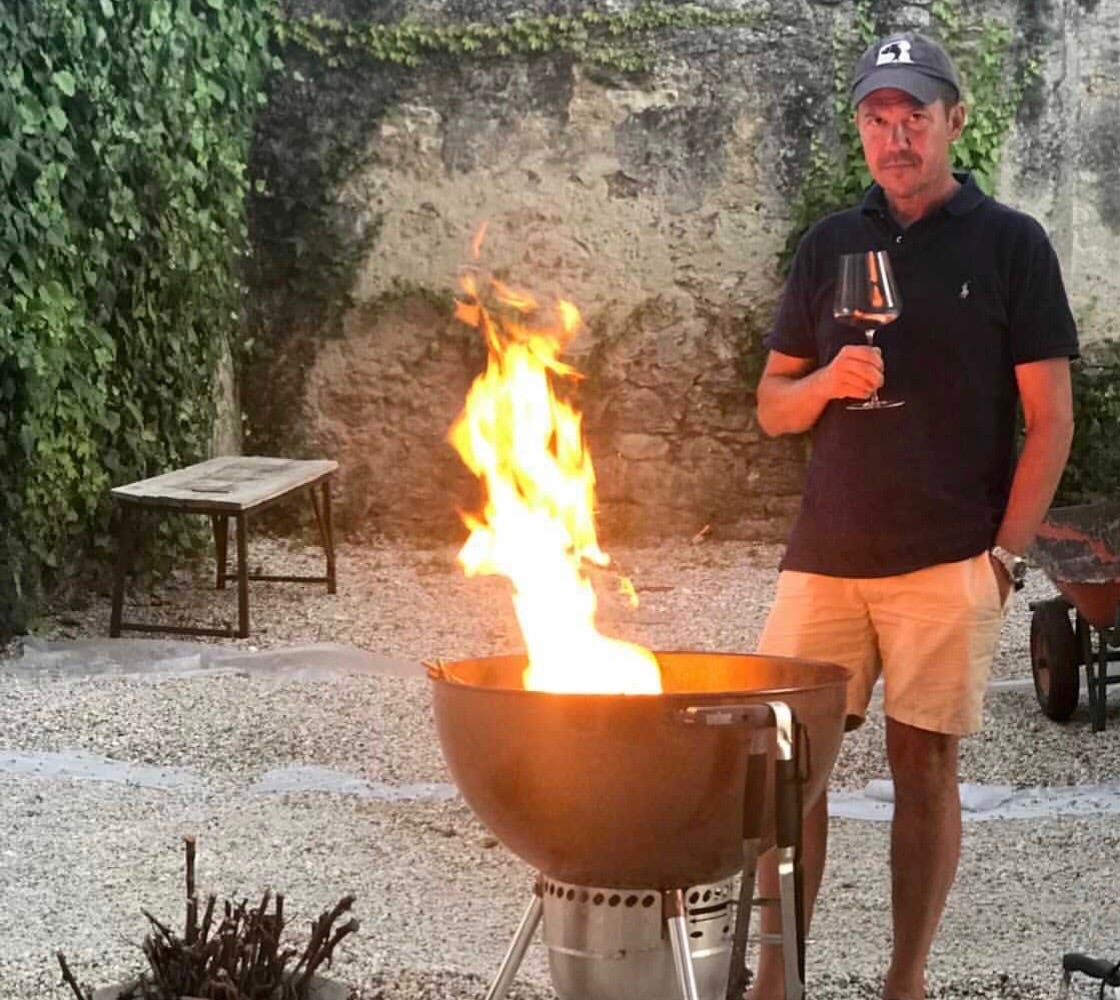
Salut from the Médoc where every meal is a grilling affair. I’ve been dying to try something out of my friend Ari Kolender’s new seafood cookbook, and since we get piles of shrimp around here, his miso shrimp is a welcome alternative! (Wish me luck on finding miso here!) I’ll be heading back to NYC next week–for our rooftop bash on Tuesday, August 5th at the Times Square Edition from 6:30-8:30pm to celebrate our Wm Brown and Yolo Journal summer issues. Negronis, martinis, and more—our paying subscribers to newsletter and/or print are invited—please RSVP to rsvp@wmbrownproject.com.
Don’t forget that the first-ever Wm Brown Q&A is happening in the August 3rd edition of this newsletter. Ask your questions by dropping a DM on the Wm Brown Magazine Instagram, sending to our chat on Substack, or by leaving a comment on this post below. Closing the window on questions at 12pm Tuesday, so get them in!
I GOTTA GUY
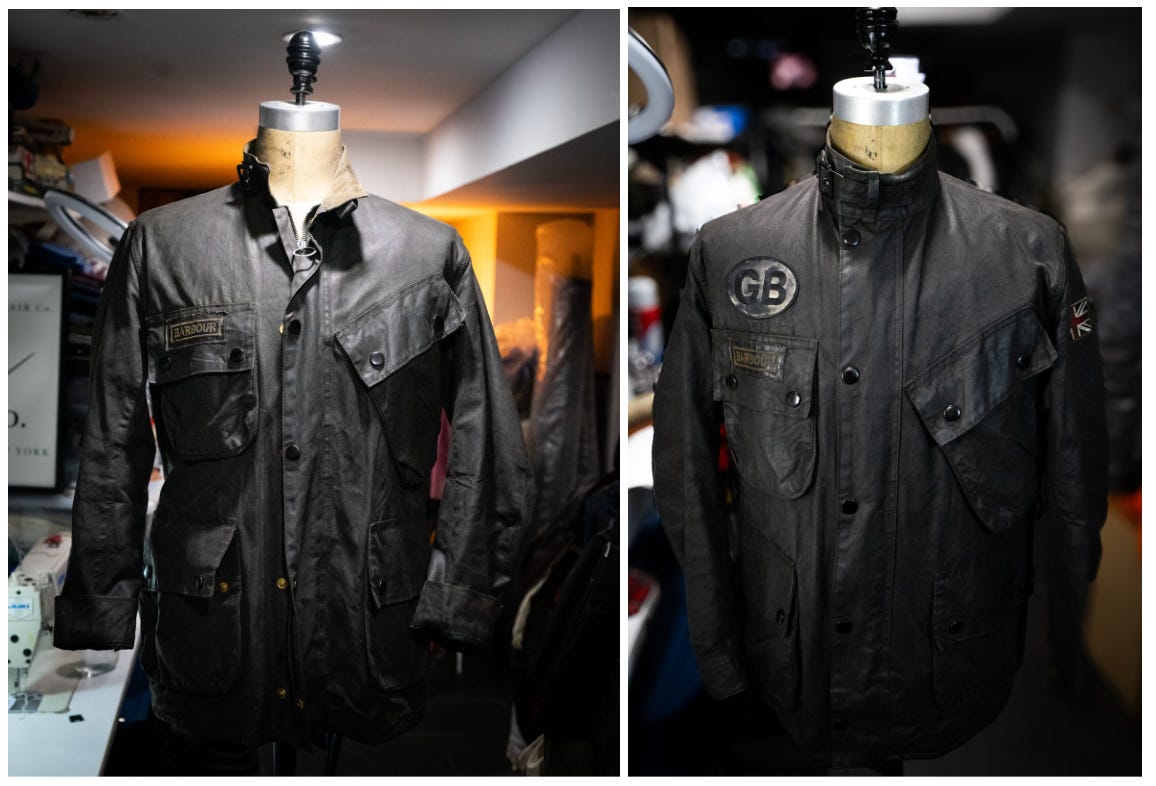
Raffael Flores-Contreras—proprieter of the Buchwick-based garment repair business Raw Meat & Repair Co., which was featured in Wm Brown #15—recently restored two meaningful pieces belonging to the Wm Brown team. First up, a jacket of Matt’s that he thought was so far gone that he should just sell it, and second, a pair of Eric’s RRL jeans that needed serious attention.
It’s no surprise that I’m a Barbour/waxed jacket obsessive. The first one I ever bought new was a Barbour International, which became a kind of signature look for me and I soon became obsessed with trying to find the perfect vintage one. I eventually I found several, but over time they got lost in my own personal archive among dozens of Bedales, Beauforts and Belstaffs.
In a bout of spring cleaning, I recently pulled it out and took stock of this one’s present condition: greasy, stinky and beginning to fall apart. I thought that maybe it was time to let it go. But I also knew how special it was, and didn’t want to just let it go for nothing..

So I brought it out to an Alfargo’s Market to see if it could find a buyer, and Raffael made a beeline for it and started telling me how much he loved it. I agreed with how great it was, but told him I was looking to sell, based on its less-than-stellar condition. He simply responded “No, give this to me—we’re going to turn it into something amazing.” And I thought that if anyone was going to do it, it’d be Raffael and I totally trusted him and his vision.
Fast forward a few weeks, and the jacket returned clean, freshly re-waxed and repaired in that special way that only makes it better. In particular, I love how Raffael added two weathered patches that looked like they’d been a part of the jacket forever—a “GB” and a Union Jack—and also added utilised an original tartan Barbour lining from British millenarian to patch up the holes on its interior, secured with white sashiko stitching. I’d argue that it’s a little bit cooler than when it was brought in, and that’s really the highest compliment that you can pay a repair job. —MH
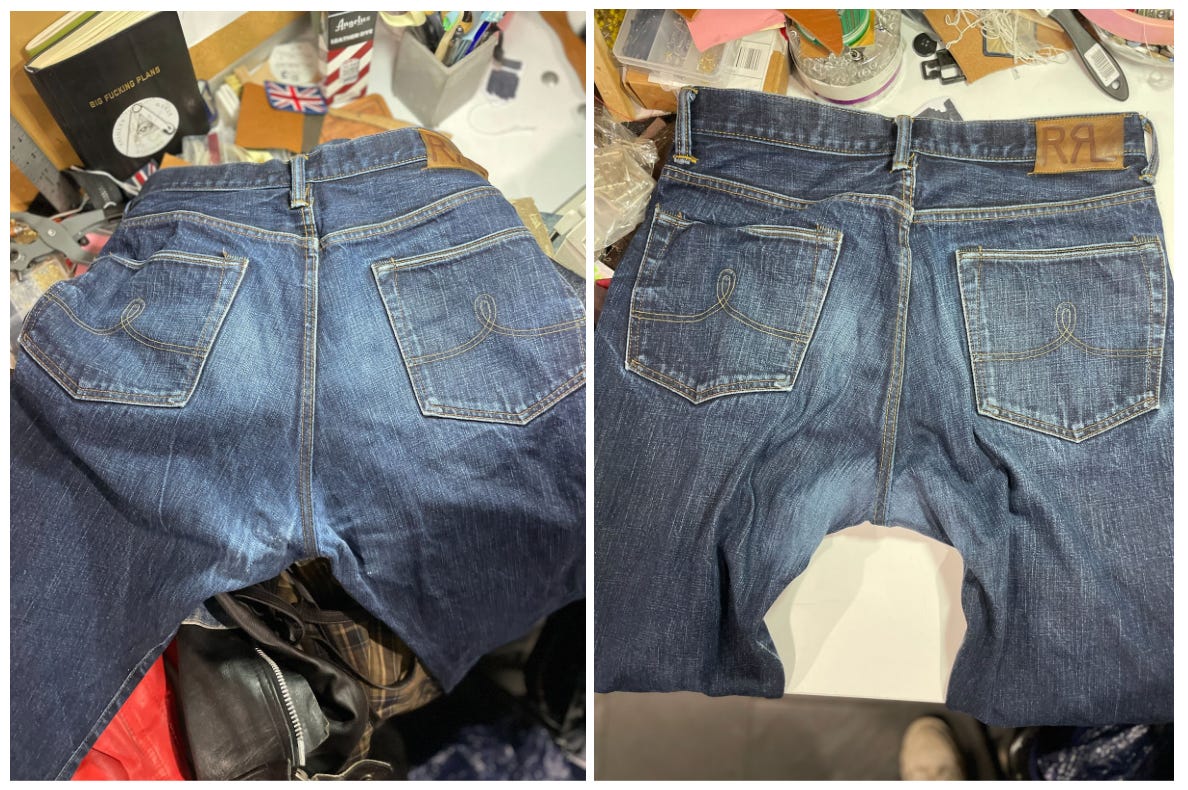
You know that creeping sense of dread that comes with thinning fabric in the crotch of your favorite pair of jeans? That’s what I was experiencing more than ever after the last wash of my beloved RRL Vintage 5-Pockets, which I’d bought a little under five years ago. In that time, they’d absorbed the strain of everything from the move into my wife and I’s first home, to riding horses in the New Mexico desert to kneeling on the floor beside my son as he learned to hold his head up. In other words, they’d witnessed way too much of my life to be relegated to the trash heap after a crotch blow-out.
So I contacted Raffael, who encouraged me to stop wearing them—immediately—and send them off to Bushwick for a fix before the fabric tore. They were soon subject to his signature reweaving technique, which utilizes three to five differently colored threads to better mimic the well-worn denim’s weight and patina, making it a far more subtle fix than just ironing a patch on. In addition, he added a soft gauze backing to reinforce and stabilize the areas where the fabric had thinned.
I’m not sure what the next five years have in store for me, but I feel confident that my jeans will be a part of them. —Eric Twardzik
THE RECIPE
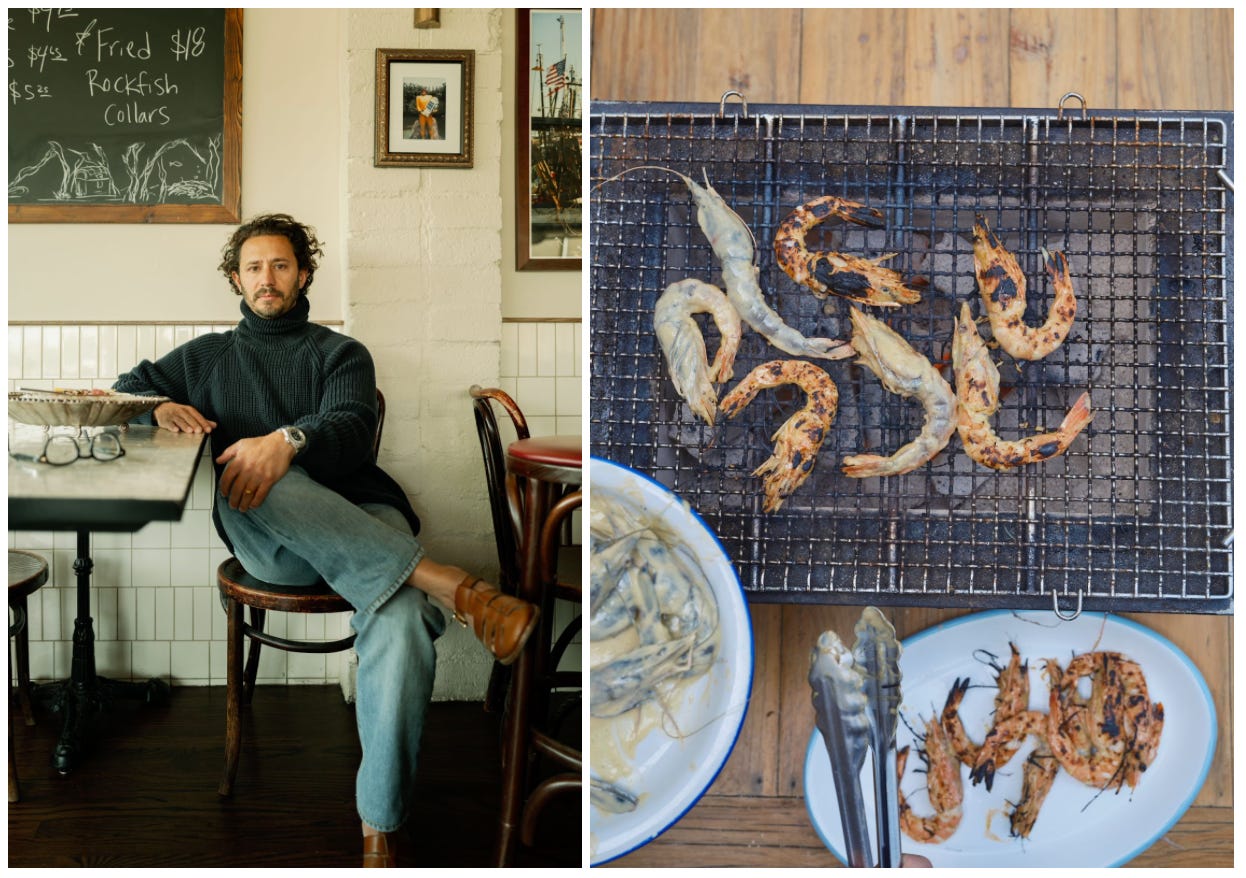
I’ve followed chef Ari Kolender’s career with interest for years. As the proprietor of Found Oyster and Queen’s Raw Bar & Grill in Los Angeles, the South Carolina native has been doing the lord’s work bringing East Coast-style seafood out west (the aforementioned restaurants are inspired by the oyster bars of New England and Charleston, respectively).
So my ears perked up when I heard that Ari had a book out with Artisan Books this past spring, simply titled How to Cook the Finest Things in the Sea. I asked Ari to pick something simple from its 100 recipes that readers could fire up on the grill at home, and he was kind enough to provide his take on Miso BBQ Shrimp, which is excerpted in its entirety below. -MH
Miso BBQ Shrimp (Serves 4 to 6)
Some recipes will tell you to grill shrimp with the shell on, since it protects the shrimp from toughening up on the high heat. Here, a thick miso marinade acts as barrier between the soft flesh of the shrimp and the heat, so that you can cook your shrimp already peeled. The shrimp should marinate for at least 2 hours to soak up all the flavor, but they can sit for up to 12 hours, which means this is a great dish to make ahead. If you’re bringing the dish to a barbecue, for example, you can transport the shrimp in the container that they’re marinating in and then, after 5 minutes on the grill, all they need is a hit of olive oil, lemon juice, and thyme.
Ingredients
1/2 cup (140 g) white miso
1/2 cup (120 ml) apple cider vinegar
1/4 cup (70 g) Dijon mustard
2 tablespoons mirin
2 teaspoons Worcestershire sauce
4 garlic cloves, peeled but whole
8 thyme sprigs (see Note), leaves picked
32 large shrimp (about 2 pounds/ 910 g), peeled, tails left on
To Finish
Kosher salt
Neutral oil, such as grapeseed or canola, for the grill
Olive oil, for drizzling
Lemon halves
2 thyme sprigs, leaves picked
Note: Instead of thyme you can use any hard herb, such as oregano, marjoram, or rosemary.
Steps
In a blender, combine the miso, vinegar, mustard, mirin, Worcestershire, garlic, and thyme and blend until quite smooth.
Place the shrimp in a nonreactive, sealable container. Pour the marinade over them and toss until well mixed. Allow the shrimp to marinate, covered, in the refrigerator for at least 2 hours and up to 12.
To finish: When you are ready to cook, preheat a grill to high heat for at least 15 minutes.
Lay the shrimp out in a single layer in a sheet pan. Season them all lightly on top with kosher salt. Grease the grill grates with neutral oil.
Add half of the shrimp, salt side down, to the grill in a single layer, then season the top side with salt. Once the shrimp are an opaque color and have some blackened grill marks on the bottom, 60 to 90 seconds, flip them over and cook the other side for another 60 to 90 seconds.
Transfer the cooked shrimp to a platter and immediately drizzle with some olive oil, squeeze some lemon juice over them, and sprinkle with half of the thyme leaves.
Clean the grill grates with a grill brush to get rid of any leftover burned, carbonized marinade and then repeat the process with the remaining shrimp, layering the second batch of cooked shrimp over the first batch and topping them with more olive oil, lemon juice, and the remaining thyme leaves.
Serve Immediately.
HOW TO COOK THE FINEST THINGS IN THE SEA by Ari Kolender, Artisan Books, 2025.
SMOKING SECTION
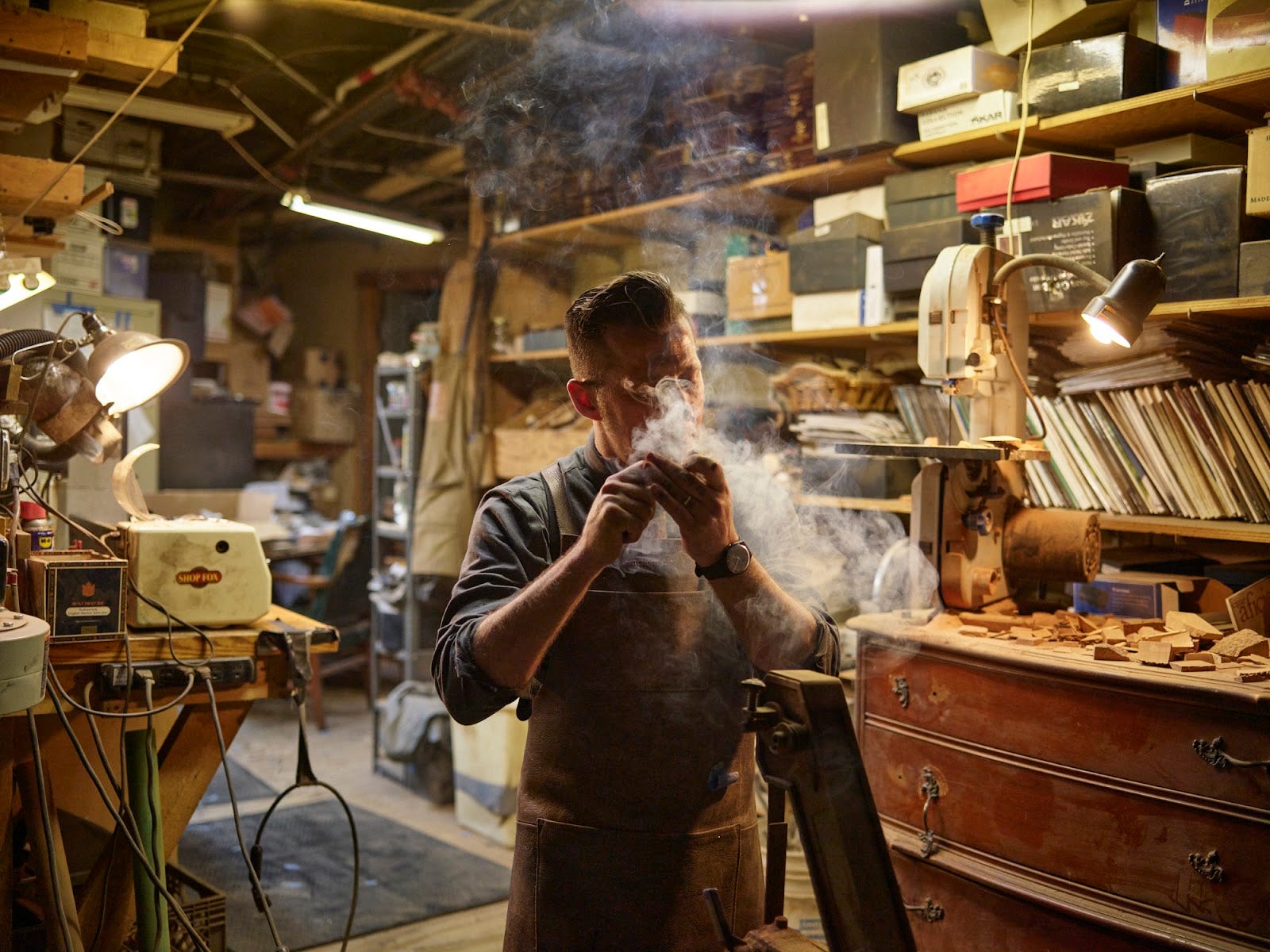
In our most recent summer issue I told the story of L.J. Peretti, a 155-year-old tobacconist that I’ve lived in the near vicinity of for my entire 16 years in Boston. I’d been inside of it before to buy cigars, but it wasn’t until I wrote my story for Wm Brown that I realized how central pipe tobacco was to the business (its present owner, Stephen Willett continues to blend it in the back), and before our photo shoot was done I’d been sold on a “starter” briar pipe myself.
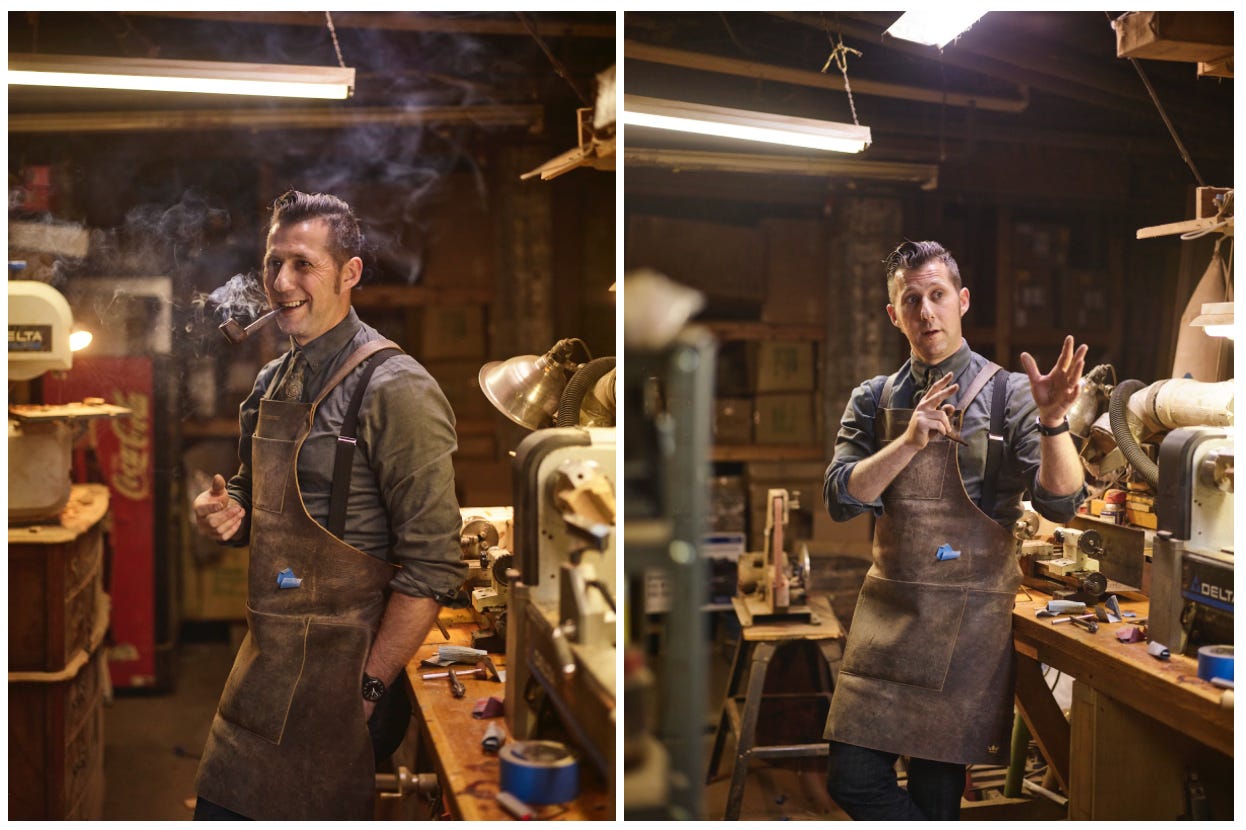
I knew less than zero about how to smoke it, but luckily I received some on-site instruction from Todd Brugman, who knows a thing or two about the subject as the shop’s in-house pipe maker. So for the benefit of other pipe-curious readers (and myself), I got Brugman back on the horn for some pipe-smoking 101. —ET
What makes pipe tobacco different from other tobacco products?
It is different in the sense that wine is different from whiskey, even though you may get the same effect from it, but they're made from different things and have different flavor profiles. So, in a way it's apples and oranges, but it is also the same thing. The actual tobaccos are grown from different strains: same genus and species but different types such as Burleys, Virginias, Orientals, Latakia, Perique, and Cavendish. Different cuts that produce completely different flavor profiles. And then the cadence, the temperature and the device which you use to smoke it is different, so it produces a different way of enjoying tobacco and of relaxing.
I often refer to pipe smoking as the very “Western” meditation. You have the aroma, which is almost like aromatherapy. You are focusing on your cadence, much more so than a cigar, especially in the beginning. Instead of big puffs once every minute or two, it's smoke puffing more often, but in these long, slow, gentle 15-second inhales of slowly pulling it into your palate and then slowly blowing it out. And after a while, that becomes automatic. Like if you were doing meditation: at the beginning you would have to really focus on your breathing, slowing it down, getting that cadence correct, and then it becomes natural.
That combined with the aroma helps to strip the outside world away. So instead of someone taking a five-minute cigarette break or a little bit of nasal snuff and getting that nicotine fix, , the physicality of what you're doing with the pipe and the tobacco brings you into this very meditative zone that allows you to relax.
What’s the basic kit to get started?
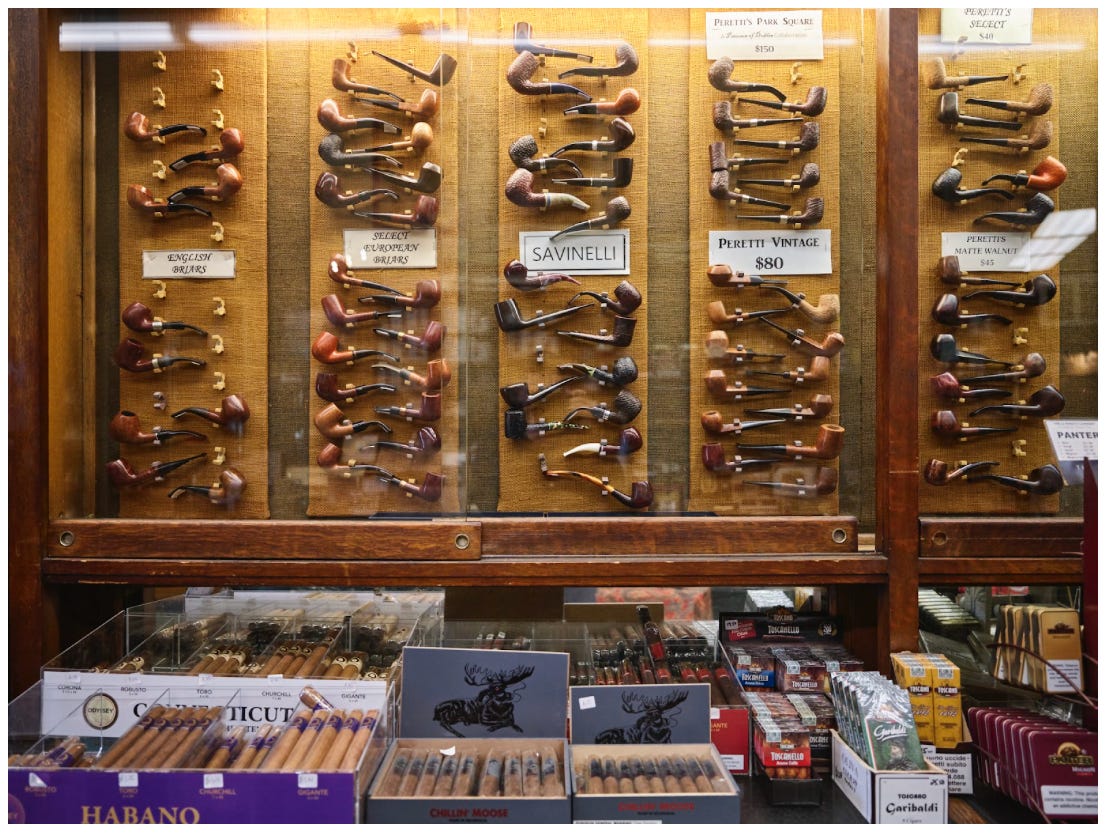
You need a pipe, you need tobacco, pipe cleaners, and a tamper, or some sort of pipe tool that would have a tamper on it. And that is it. The most expensive of which is always going to be the pipe. A beginner pipe smoker should not go for a very expensive pipe. Just a briar pipe which is going to run $35 to $50.
You could spend more than that, but I absolutely would not want someone to spend three, four or five hundred dollars on a pipe until they start to realize what they are looking for: a taller or shorter pipe, a wider or a narrower tobacco chamber, which is like how the size and shape of the cigar is going to affect the flavor and the length of time that it burns. But starting out, you don't know what you like and there’s no wrong answer.
Yet there is a big difference between a $35 pipe and a $500 pipe. The engineering, the quality of the briar, the stem material, and how those are engineered together. You most likely won't notice those nuances staring out. But after a couple of years of smoking, you absolutely will notice what makes one pipe a Ferrari and one pipe a go-kart.
How would you explain technique to first-timers or novices?
You’re going to take the tobacco and fill up the tobacco chamber, however that works for you. If you talk to different people, you'll get different packing techniques. If you go online, there are different packing techniques. Nobody that I know that has been smoking a long time uses any of those techniques. They just get the tobacco in there in a way that works for them. It really just has to do with the density of it, and the draw of it. So when you pack the tobacco in there and you draw it, it should feel the way a cigar should feel. Or a good example is that it should feel like a milkshake, where you can pull on it but it's not completely open. And you can always use your tamper to tighten it down as you go.
The first light is often referred to as a “false light”. It might be the first two lights where you're puffing quite a bit while you're holding the lighter or match or to it. But you do not want to use a torch lighter, what's referred to as a soft light. It could be a Bic lighter, a fancy S.T. DuPont, or matches. So you're holding that to it, you're puffing quite fast. Often you might even tilt the pipe a little bit to the side, and you're puffing, and it's going to char the top of it, and then it often expands a little bit, and then you tamp it back down, and you're essentially putting it out. You're probably going to have to repeat it once or twice, and then you’ll puff, and it stays lit. Then you start to slow down, once you get a good ember going there. You want to essentially smoke as slowly as you can so that it stays lit, but if it goes out, let it go and relight it.
The longer one smokes, the better their cadence and smoking techniques will get. One of them would be tamping. You don't want to dump out the ashes as you go. You gently tamp down the ashes just as you would after that first false light. That helps it stay lit, because sometimes you’ll have an ember going, and it will feel like nothing's burning, you're not pulling anything in. Well, that ember might not be really touching the tobacco underneath. So, gently tamping will push that ember down, helping it burn evenly and slowly.
If it ever gets too hot to comfortably hold, you're smoking too hot or the pipe isn't fully broken in, or possibly a combination of both. Let it completely go out, cool down, and then you can come back to it. And if you hear a gurgling noise, that's because when things burn, they're going to push moisture towards the bottom of the chamber. If you leave that moisture there, that can turn into hot steam that can burn your mouth. That's often referred to as “tongue bite”. It can be avoided by using pipe cleaners during the smoke. If you hear any sort of gurgling noise down there, take the pipe cleaner, run it right through the stem shank into the chamber, pull it out and go back to puffing. And if you still hear it, flip that pipe cleaner around and use the other side and then toss it away.
You might do that two to three times for a pipe. It's rare to get through a whole pipe without doing it at all. It's a very common thing even amongst regular pipe smokers that have been smoking for decades.
There's always going to be unburned tobacco, but don't go crazy trying to light that at the bottom. Dump it out—all you're doing is removing the wet tobacco at the bottom of the pipe that didn't burn.
You’re not going to clean the pipe in any way. You want to season it. Run a pipe cleaner through the stem and the shank to clear out the draft hole, because you don't want to build up any carbon cakes or resins in there. Run a pipe cleaner through there, and then you put your pipe down to rest.
What's the best type of tobacco to start out with?
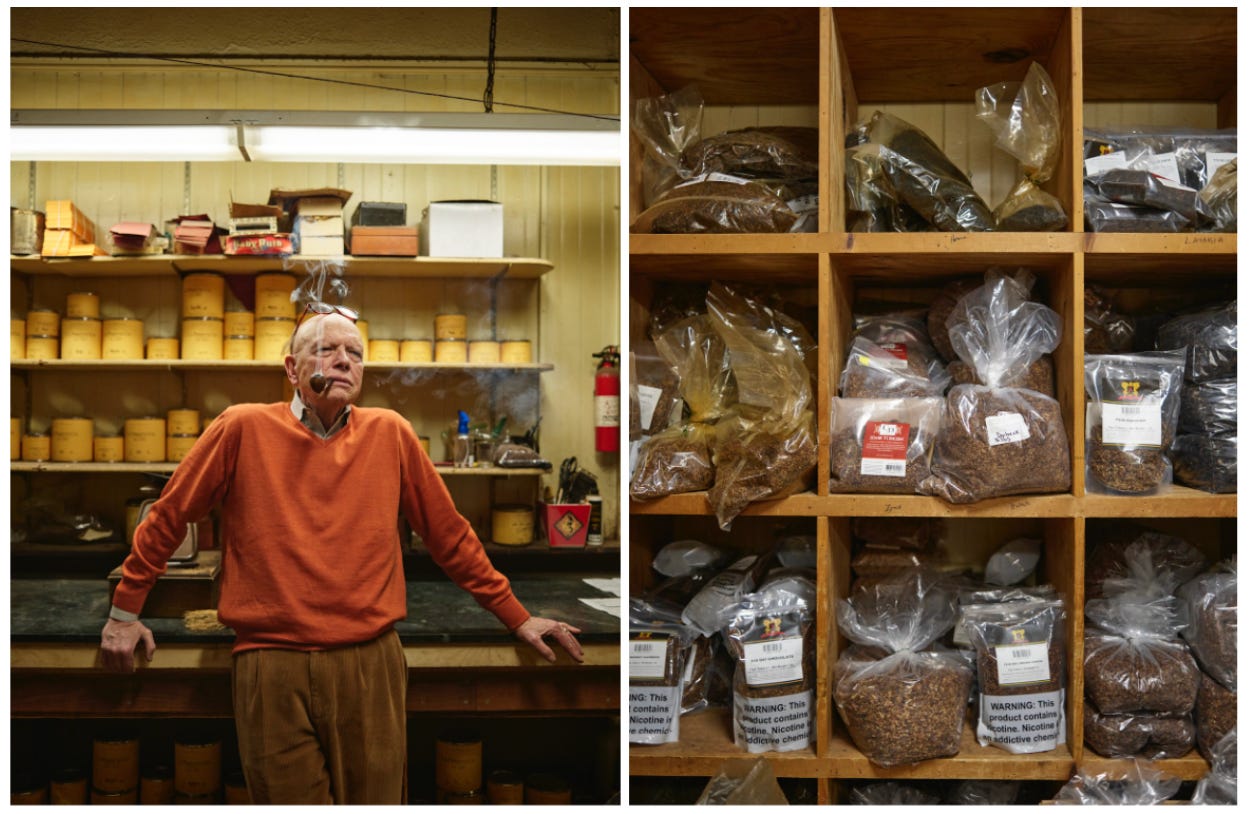
There are three main genres of pipe tobacco: Cavendish, Burley and English. Here in the United States, Cavendish is aromatic. Elsewhere, it may be quite different. Burley is considered a traditional American tobacco. In the late 19th and early 20th centuries it was a very common drugstore tobacco.
There was something that used to exist called the English Tobacco Purity Laws. They ended in the early ‘70s. And they prohibited the use of any flavoring agents. Therefore, English tobacconists had to get creative and they used what's referred to as “condimental” tobaccos. English tobaccos are intrinsically non-aromatic, often very smoky and leathery, but there were loopholes where they could flavor them by resting them on vanilla beans to absorb the flavor.English Burley tobaccos could be aromatic or non-aromatic, but typically not sweet. They were often very fragrant, especially in the 1920s, when almost perfumey style fragrances were used in the tobaccos. And then you have aromatic Cavendishes, which really got popular in the mid to late 1960s. And that's often what people think of when they think of pipe tobacco: “Oh, that sweet tobacco that my grandpa smoked.” They're thinking of aromatic Cavendish tobaccos. And those also tend to be the most forgiving. They're easy on the palate, fairly easy to light and keep lit and smoke relatively cool.
When you rate tobacco, one of the ratings is often referred to as “room note”, how pleasant it is to the people around you. They would have a very high rating of room note, four or five out of five stars. It has to do with the processing of Cavendish tobaccos where the starches get turned to sugars under the pressure and steam and then they're often cured with vanilla beans and different food additives to absorb that flavoring and then give off that aroma, whether it's cherry, vanilla or other complex tobaccos.
There's one we make here at L.J. Peretti that doesn’t have a fancy name. It's called Blend 432. It's by far the most popular aromatic Cavendish we make. It's typically what I would start someone off with. It has notes of vanilla, cocoa, rum, and coconut. It's quite nuanced which I think is why a lot of people like it. You can't really point your finger at one certain flavor, but it has a very pleasant aroma, and an easy, light taste.
When someone gets a little more seasoned and wants to expand their palate, what direction would you point them in?
I would refer people to Burley or English. If they're looking for something more nutty or stronger nicotine-wise, then I might go in the Burley direction. If they're looking for something very smoky and leathery, strong in a flavor but not necessarily strong in nicotine, I would go in the English direction.
English, which is very different from an aromatic Cavendish, is what people go to next, and it might be the most popular genre for people who are long-term pipe smokers. The flavor is much more condensed and robust than any cigar, which I find interesting because the nose or the room note is going to be much lighter.
There's a condimental tobacco that's used in many English tobaccos called Latakia, which is an Oriental tobacco that’s smoked with different seasonings. It originally came from Syria. Due to different political and economic factors it now comes from Cyprus, but it was invented in Syria.
Another common condimental tobacco is Perique, which comes from one particular place, St. James Parish, Louisiana. There are only two farmers there that make it. It was a Native American method of fermenting tobacco that was taught to farmers three or four hundred years ago, and it's been passed on through generations. It takes a long fermenting process, and you get this grayish black tobacco that is very pungent. It has a very plummy yet spicy flavor. It's a quite strong tobacco in both flavor and nicotine strength and when it's used it's used in small amounts, two to three percent. Occasionally 10 to 20 percent, which would be very high and that’s almost all you’re going to taste.
You also have Oriental tobaccos. It's very hard to describe the flavor. I find them to be slightly aromatic, but not as aromatic as an aromatic Cavendish. They almost have a metallic-y smell or taste, but not in a bad way. They add a lot of body and character. They function the way salt functions in a chocolate chip cookie, where you don't taste the salt, but it really adds structure and body to that smoke.
There’s a wide breadth of what could be an English tobacco. But often it's something with a Virginia base, with a little bit of Latakia and Oriental tobaccos in it, possibly a little bit of Perique too, and it creates this complex, smoky, earthy tobacco with a natural sweetness to it.
How long does it take to become a pro?
It's somewhere between three months and a year to really get it down, and you have to be comfortable learning. People that are comfortable learning something new and are all right saying, “Hey, I don't know everything, I can ask questions and I can just still enjoy myself during this learning process” are the people that are going to get the most out of it.
If you’re hosting family for an Italian Christmas dinner, what’s on the menu, including drinks? Thanks!
For the Q&A: best places to live if you are a traveler, I mean places that are good as a home base, internationally, not only US cities